
Local Lead Generation: Apex Media's Proven Strategies for Service Businesses in 2026
Local lead generation focuses on attracting nearby prospects who are ready to hire service businesses, and it works by matching local intent with visible, trust-building signals to convert searches into calls and bookings. This article explains practical, proven tactics—from dominating local search and optimizing Google Business Profile to targeted local advertising, community engagement, conversion-focused pages, and modern AI/CRM workflows—that reduce customer acquisition cost and increase booked jobs. Service businesses such as plumbers, HVAC companies, electricians, and landscapers benefit especially from strategies that prioritize phone calls, immediate bookings, and reputation signals because local intent converts at higher rates than broad, generic traffic. Readers will get an actionable roadmap: why local lead generation matters, how to optimize search and profiles, which paid channels produce the best ROI, community and referral playbooks, website and mobile conversion techniques, and practical AI/CRM automations to scale follow-up. If you want help implementing these tactics faster, book a Discovery call.
Indeed, a comprehensive approach to professional services marketing is essential for developing robust lead generation strategies and building a strong brand.
Lead Generation Strategies for Professional Service Businesses
Implementing a proven marketing communications program that works in any economy • Developing a lead generation strategy that attracts a strong, steady flow of new clients • Building a powerful brand that differentiates your firm from the competition • Creating a culture of business development success throughout your firm • Leveraging the latest online marketing techniques to generate leads and build your brand
Professional services marketing: how the best firms build premier brands, thriving lead generation engines, and cultures of business development success, 2013
What Is Local Lead Generation and Why Is It Crucial for Service Businesses?
Local lead generation is the process of attracting potential customers from a defined geographic area and converting them into qualified contacts for local service delivery, and it works by aligning discoverability, reputation, and easy contact paths so intent becomes a booking. The reason it matters for service businesses is simple: local searches carry high commercial intent, phone calls and on-site visits drive revenue directly, and properly optimized local channels lower CAC while improving lifetime customer value. Recent market trends show that consumers increasingly use maps and voice search for immediate service needs, which makes local visibility a strategic priority for businesses that rely on geographic proximity. Understanding these mechanisms sets up the tactical sections that follow: search dominance, paid local advertising, community engagement, website conversion, and automation.
Local lead generation delivers measurable business outcomes in three main ways:
Faster conversions: Local intent drives quicker decision-making and higher booking rates.
Lower acquisition cost: Targeted local channels reduce wasted ad spend and improve ROI.
Repeat and referral potential: Local customers provide word-of-mouth and recurring work.
These benefits make local lead generation an essential component of any business growth strategy, and the next section explains how those leads actually turn into revenue through a predictable funnel.
How Does Local Lead Generation Drive Business Growth?
Local lead generation drives growth by creating a short, measurable funnel: discoverability leads to contact, contact leads to appointment, and appointment leads to revenue and referrals; each stage can be optimized and measured. Visibility in local search and maps increases qualified inbound calls and direction requests, which strongly correlate with higher booking conversion rates for service businesses. Representative KPIs include GBP views, phone call volume, website direction clicks, and booking conversions; a typical lead-to-booking conversion for vetted local traffic often outperforms broad digital channels. For example, an anonymized plumbing contractor doubled monthly booked jobs within three months after prioritizing GBP optimization, targeted ads, and a streamlined booking page that reduced friction for mobile callers.
Optimizing the funnel requires tracking at every step—from impressions to booked job—to identify bottlenecks. Measuring these KPIs allows businesses to invest more in high-performing channels and scale outreach with predictable ROI, which naturally leads into the common obstacles teams must overcome when executing local strategies.
What Are the Key Challenges Service Businesses Face in Local Lead Generation?
Service businesses commonly face limited marketing budgets, inconsistent reputation management, fragmented tracking, and seasonal demand that complicates forecasting and hiring decisions. Limited budgets force trade-offs between organic local SEO and paid ads, while inconsistent Google Business Profile data and missing citations reduce visibility across directories. Poor call tracking and lack of CRM integration mean leads are lost or not attributed correctly, reducing the ability to scale effective channels. Each challenge has pragmatic mitigation steps—budget prioritization for high-intent channels, a reputation program for reviews, consolidated citation cleanup, and implementing simple call-tracking and CRM workflows to capture and route leads.
Addressing these challenges directly improves lead quality and reduces waste, which sets the stage for tactical optimization of local search and GBP in the next section.
How Can You Dominate Local Search with SEO and Google Business Profile Optimization?
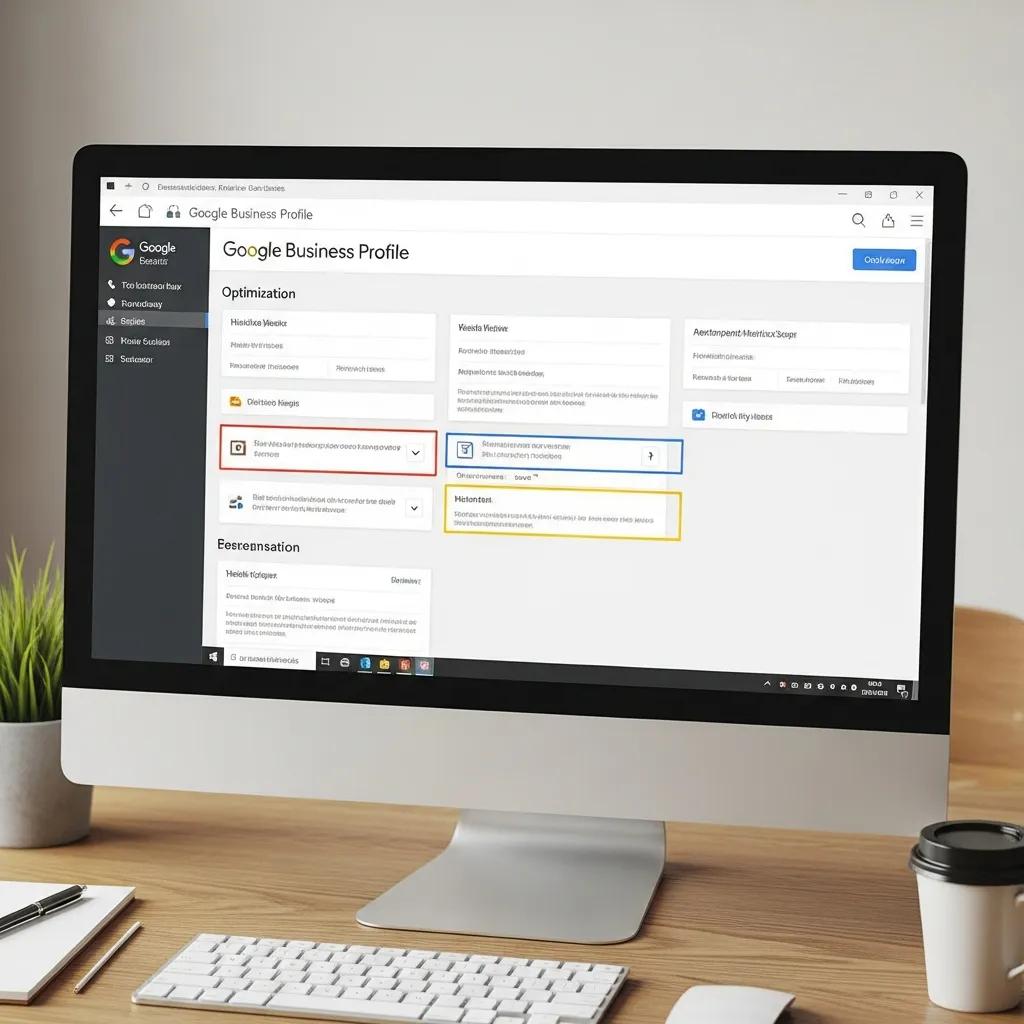
Dominating local search requires a two-track approach: an optimized Google Business Profile (GBP) that captures immediate intent in the local pack, and on-site local SEO that signals relevance for area-specific queries. GBP optimization increases visibility in map-based results, while structured location pages, schema markup, and local keywords increase organic rankings for service-area queries. Reputation management—systematically collecting and responding to reviews—reinforces trust signals and improves click-through and conversion rates. Below is an EAV-style comparison of GBP fields and typical impact to guide prioritization.
Indeed, recent research underscores the critical role of an active and updated Google Business Profile in enhancing local search visibility and fostering customer trust.
Google Business Profile for Local Search & Business Growth
This study focuses on how businesses could grow and show appear in local search results by using Google Business Profiles (GBPs). Before going to a store or using a service, a lot of people today perform a search on the internet, and Google Business Profile is crucial in helping local businesses connect with clients. The study examines how information such as a company's location, contact information, hours of operation, website link, reviews, and images affect consumers' choices. It also looks into how a company's visibility on Google Maps and in local searches is enhanced by an active and updated profile. The study uses surveys to learn more about how people use Google Business Profiles when searching for local goods or services to better understand this. It is expected that the results will show that businesses with detailed and regularly updated profiles bring in more customers, get better feedback, and gain more trust among consumers. Based on the study's findings, Google
A STUDY ON THE IMPACT OF GOOGLE BUSINESS PROFILE ON BUSINESS SUCCESS, B Sharma, 2025
What Are the Best Practices for Google Business Profile Optimization?
Optimizing Google Business Profile begins with accurate NAP (name, address, phone) and selecting the most relevant primary and secondary categories that reflect core services, plus adding high-quality photos and a concise business description. Use service listings to surface specific offerings, enable booking links or call buttons to capture immediate intent, and publish GBP posts regularly to indicate activity and recent promotions. Monitor and answer Q&A promptly and respond to reviews professionally to reinforce trust signals; consistent responses also improve engagement metrics. These tactics collectively increase map visibility and direct contact actions, which directly translate to more qualified local leads.
A compact checklist helps prioritize low-effort, high-impact tasks for immediate wins.
Ensure NAP consistency across profiles.
Choose accurate business categories and list core services.
Add high-resolution photos and recent posts.
Enable call-to-action links and booking if available.
Following this checklist reduces friction for local searchers and primes profiles to convert interest into direct phone calls and bookings, which naturally ties into on-site local SEO tactics covered next.
How Do Local SEO Tactics Like Local Citations and Keyword Research Boost Visibility?
Local SEO tactics such as citation building and cleanup, targeted local keyword research, on-page location pages, and schema markup help search engines associate your business with specific service areas and queries. Citations—mentions of your business across directories—establish authority and consistency; auditing and fixing inconsistent entries prevents ranking loss. Local keyword research identifies phrases customers use (e.g., "emergency plumber near me" or "HVAC repair [city]") and drives copy and meta optimization for location pages. Implementing localBusiness schema and internal linking to service-area pages helps search engines map services to geography, improving rankings for intent-driven queries.
Further research emphasizes that effective local SEO, including Google My Business optimization, is crucial for increasing organic traffic and achieving advantageous placement in local search results.
Local SEO & Google My Business for Organic Traffic
The Purpose of the presented research is to substantiate the importance of the local optimization of the retailer’s business for search engines to increase organic traffic; to represent insights and give practical recommendations for retailers regarding local optimization of their business in Google as part of an effective marketing strategy; to create the typical valid data micromarking (by the example of the Ukrainian retailer), which will contribute to an advantageous placement in the Local Pack in comparison with competitors, and increase organic traffic and conversion.
Business optimization in the digital age: Insights and recommendations, A Natorina, 2020
A short local citation action list helps teams prioritize cleanup and opportunities:
Audit top directories for NAP consistency.
Update and enrich listings with services and photos.
Create dedicated location pages with unique content and schema.
Cleaning citations and aligning on-page signals makes other channels (ads, GBP) more effective by increasing organic trust and discovery.
Which Targeted Local Advertising Strategies Effectively Generate Leads for Service Businesses?
Targeted local advertising mixes channel selection, geographic radius targeting, and creative that prompts high-intent actions (calls, bookings) to deliver scalable leads. Platform choice should match intent: Local Service Ads and Google Search capture transactional intent, while geo-targeted social ads build awareness and remarketing lists for later conversion. Budgets should focus on cost per lead and lead quality rather than clicks alone, and ad setup must include tracking mechanisms to measure call conversions and form submissions. The table below compares common platforms, their best use cases, and expected KPI outcomes to help choose the right mix.
Further studies emphasize that understanding campaign quality factors like ad relevance, CTR, and landing page experience is crucial for optimizing Google Ads performance and achieving digital marketing success.
Google Ads Campaign Quality & Performance Optimization
Despite the proliferation of digital advertising channels, Google Ads remains critical in digital marketing. A synthesized understanding of the specific impact of campaign quality in the Google Ads advertising ecosystem has received limited attention. This study addresses this research gap through a PRISMA-based systematic review of 49 peer-reviewed articles published between 2007 and 2024. The review identifies and categorizes the main factors that define campaign quality, such as ad relevance, click-through rate (CTR), landing page experience, and conversion rate. We propose a comprehensive conceptual framework linking these dimensions to digital marketing results based on these findings. This paper also presents data-driven optimization strategies to improve campaign performance. Finally, key metrics for evaluating the results of advertising campaigns were identified based on the existing literature. The proposed model is a practical guide for digital marketers to successfully implement advertising campaigns in Google Ads and evaluate their performance.
The relationship between campaign quality and performance in Google Ads: a systematic review, M Shemshaki, 2025
How Do Google Local Service Ads and Geo-Targeted Social Media Campaigns Work?
Google Local Service Ads (LSAs) operate on a lead-based model, showing vetted providers at the top of search results for local intent queries and charging per lead; they are ideal when users seek immediate service. Setting up LSAs requires verification steps and ongoing lead response processes to maintain placement, so businesses need rapid intake and follow-up workflows. Geo-targeted social campaigns on platforms like Facebook allow granular radius targeting around service areas, layered with demographic and behavioral signals to reach homeowners or specific audience segments. Both approaches need conversion tracking—call tracking numbers or form pixels—to measure true ROI and optimize bids and creative for the highest-quality leads.
A short ad-vetting checklist helps ensure measurable campaigns:
Implement call tracking for all ads.
Define clear lead qualification criteria.
Set conservative initial budgets and optimize for lead quality.
These operational steps reduce wasted spend and increase the proportion of leads that become booked jobs, and retargeting further amplifies conversion lift.
What Are the Benefits of Retargeting Local Audiences?
Retargeting local audiences lifts conversion by re-engaging visitors who demonstrated interest but did not convert, and it typically improves conversion rates by reminding prospects with timely, relevant creative. For local service businesses, retargeting windows of 7–30 days are common, with shorter windows for emergency services and longer windows for seasonal or planned jobs. Creative angles should vary by funnel stage—promote urgency (same-day availability) to recent site visitors and offer guarantees or inspections to earlier prospects. Cross-platform retargeting (site pixel → social ads → search remarketing) recreates a multi-touch path that increases trust and likelihood of booking among local prospects.
Implementing retargeting requires building accurate audiences and tailoring messages to intent and recency to maximize conversion lift without oversaturating the local market.
How Does Building Community Engagement and Networking Enhance Local Lead Generation?

Community engagement and networking create predictable referral pipelines and strengthen brand awareness in target neighborhoods, which turns into repeat work and higher referral rates. Sponsoring local events, joining trade groups, and running neighborhood promotions position a service business as the trusted local expert and produce high-quality leads that convert at better rates. Referral programs with clear incentives for both referrers and new customers formalize word-of-mouth and make ROI straightforward to track. These approaches complement search and paid channels by increasing the volume of warm inbound leads and improving lifetime value through repeat business.
Below are practical partnership and referral tactics to implement quickly.
Offer a simple referral reward for customers that results in a discount or credit.
Co-market with complementary local businesses to reach new audiences.
Sponsor or attend community events with high foot traffic to generate direct conversations.
These community tactics require follow-up systems to convert leads generated offline into tracked customers, which is covered in the next subsection about associations and conversion.
What Role Do Local Events, Partnerships, and Referral Programs Play?
Local events and partnerships generate face-to-face interactions that build trust faster than digital channels, and referral programs turn satisfied customers and partners into recurring lead sources. Event participation can be structured—educational workshops, home maintenance fairs, or trade demonstrations—that capture contact information and allow immediate scheduling. Partnership lead exchanges with complementary businesses (e.g., real estate agents, property managers) can be formalized with co-branded offers or reciprocal referral agreements. Measuring ROI from these activities requires a simple attribution rule (e.g., a referral code or landing page) and a follow-up cadence to convert contacts into appointments.
A short outreach script and a basic referral template streamline partner onboarding and help turn occasional introductions into a steady lead channel.
How Can Service Businesses Leverage Local Business Associations for Leads?
Joining and actively participating in local business associations and chambers of commerce raises visibility among business owners and community members who often refer trusted providers for local projects. To maximize ROI, businesses should aim for speaking slots, sponsorship visibility, and membership directories that include enhanced profiles linking to contact or booking flows. Networking within associations yields B2B opportunities and bulk or maintenance contracts that stabilize revenue during seasonal dips. A systematic follow-up system—capturing leads from association events into a CRM and nurturing them with tailored messaging—turns association presence into measurable bookings.
Careful selection of associations aligned with your ideal customer profile and consistent attendance convert affiliation into a reliable local lead source.
How Can You Optimize Your Website and Content to Convert Local Leads?
Converting local visitors requires location-specific landing pages that answer immediate questions, simple click-to-call functionality, and lead magnets that remove friction for booking or requesting estimates. A conversion-first landing page includes clear service descriptions, trust signals (reviews, certifications), a prominent phone CTA, and a short contact form that minimizes fields. Mobile optimization is particularly important because a large share of local searches happen on smartphones and lead to immediate phone calls.
What Are Effective Location-Specific Landing Pages and Lead Magnets?
Effective location pages follow a template: local headline, short service summary, clear benefits, trust signals (reviews and local case studies), and an immediate CTA such as click-to-call or an appointment form. Lead magnets that work for service businesses include limited-time inspection offers, free estimates, or seasonal checkups that provide a clear value exchange and accelerate contact. Page copy should incorporate local keywords naturally—service + neighborhood/city—and include schema markup and internal links to the main service hub to boost relevance. A well-constructed location page reduces friction and makes it easy for a local prospect to contact you within seconds, increasing the likelihood of a booking.
A simple A/B test to run is headline variations that include vs. exclude city names to measure CTR and call volume impact.
How Does Mobile Optimization and Clear Calls-to-Action Improve Lead Capture?
Mobile optimization improves lead capture by ensuring fast load times, large tappable CTAs, and streamlined booking forms that minimize typing on small screens; these reduce friction and increase contact rates. Click-to-call buttons placed above the fold and persistent sticky CTAs for calls or bookings significantly raise phone conversion rates. Technical improvements like compressed images, server-side caching, and simplified DOM elements reduce load time and improve Core Web Vitals, which indirectly helps search visibility. Tracking mobile-specific metrics—click-to-call rate, form conversion on mobile, and time to contact—reveals the highest-impact optimizations for local lead capture.
Implementing these mobile-first changes creates a direct path from discovery to booking, and integrating the captured leads into a CRM ensures timely follow-up.
How Can Modern Technology Like AI and CRM Systems Boost Local Lead Generation?
Modern technology enhances local lead programs by speeding initial contact, improving lead qualification, and automating nurture so that high-intent prospects are routed and followed up without manual delays. AI chatbots and lead-scoring models can qualify inbound inquiries on websites and GBP messaging, while CRMs store lead attributes and enforce routing rules to ensure the right technician or salesperson responds. Marketing automation sequences—welcome messages, appointment reminders, and post-job follow-ups—preserve lead momentum and increase conversion and referral rates. Below are benefits and a short workflow to implement AI and CRM effectively for local lead generation.
Faster response: AI chat and automated SMS reduce time-to-contact to seconds.
Smarter qualification: AI-driven scoring prioritizes leads by likelihood to convert.
Scalable follow-up: Automation sequences keep prospects engaged until booking.
These technology layers make local campaigns more efficient and measurable, and if you want help evaluating tools, book a Discovery call.
What Are the Benefits of Using AI for Lead Qualification and Follow-Up?
AI improves lead qualification by analyzing inbound signals—conversation text, time of inquiry, service requested—and assigning a score that predicts conversion likelihood, enabling teams to prioritize high-probability leads. Chatbots provide instant triage for common requests, capture contact details, and schedule preliminary appointments or calls, which shortens the sales cycle and reduces missed opportunities. AI can also personalize follow-up messages and predict the best time to contact leads, increasing conversion rates and reducing human labor. Metrics to expect when using AI include faster first response time, higher qualified-lead percentage, and improved booking conversion from chat-originated leads.
A checklist for AI adoption includes defining qualification rules, integrating chat transcripts into CRM records, and monitoring model performance against conversion KPIs.
How Do CRM and Marketing Automation Streamline Lead Management?
A CRM centralizes lead capture, stores contact and job history (meronyms such as lead capture forms and CRM records), and implements routing rules so leads are assigned to the right team member by geography, skill, or availability. Marketing automation sequences handle welcome messages, appointment confirmations, reminders, and post-job review requests, ensuring consistent follow-up that converts leads into booked jobs and solicits reviews. Typical CRM workflows include capture → qualification → route → nurture → booking, with automation triggers at each stage to reduce manual handoffs. Measuring effectiveness relies on CRM KPIs like time to contact, conversion rate per lead source, and lead velocity to identify bottlenecks and optimization opportunities.
If you need help evaluating which tools and workflows fit your operation, book a Discovery call.